Journal · List · 7 min
Pocket shut down. Where did everyone actually land?
By Ziyarex ·
Mozilla announced Pocket's shutdown in May 2025. The apps stopped working that July, exports stayed open until October, and then fifteen years of a category-defining product was a zip file in everyone's Downloads folder.
It's worth doing the accounting now that the dust has settled, because the interesting finding isn't which app won. It's how many people didn't replace it at all.
First, the thing nobody wants to say
Pocket wasn't killed by a competitor. It was killed by the economics of the category. Read-later is expensive to run (you're fetching, parsing and storing the full text of the web on behalf of people who mostly don't come back) and it's very hard to charge for, because the core function feels like it should be a bookmark.
Omnivore, the promising open-source-ish challenger, folded in late 2024 after its team was acquired. Pocket went in 2025. Two of the best-known names in the category died inside a year of each other, and it wasn't a coincidence.
That should inform how you pick the next one. The question isn't just "which is best." It's "which of these has a business model that survives my next five years of saving."
Where people went
Instapaper, the safe harbour
The oldest survivor, and the most direct like-for-like: clean parsing, good typography, highlights, an actual reading experience. It's independently run and has outlived several better-funded competitors, which at this point counts as the strongest possible endorsement.
Take it if you want what Pocket was, with fewer surprises.
Readwise Reader, the maximalist option
Read-later merged with highlight management, RSS, newsletters, PDFs, YouTube transcripts and spaced-repetition review. Genuinely the most capable thing in the category, and priced accordingly.
It's also the one most likely to become a second job. If your Pocket queue was already a source of guilt, adding four more input types to it is not the fix.
Raindrop.io: bookmarks that grew up
Strictly speaking a bookmark manager, which is why a lot of Pocket refugees landed here: nested collections, tags, good search, a generous free tier, and a clear paid plan behind it. Reading is the weaker half, it saves and organises links better than it renders articles.
Take it if what you actually wanted was a library, not a queue.
Wallabag and self-hosting, the "never again" crowd
The reaction to being shut down twice is, reasonably, to stop depending on anyone. Wallabag is the mature open-source option and it works; it also means you now operate a small service, complete with a server, updates and a backup story.
The honest version: this is the right answer for maybe one reader in twenty, and the other nineteen will have an unmaintained instance within a year.
Browser reading lists and the Notes app, the quiet majority
Safari's Reading List, Chrome's reading list, or just pasting URLs into Apple Notes. No parsing, no highlights, no sync guarantees beyond your browser vendor's whim, and no cost or setup.
This is where far more people went than any vendor's migration blog post admits, and for light savers it's a completely defensible answer.
Nowhere, the largest destination
The pattern in every conversation we had about this: people exported their Pocket archive, looked at 2,400 saved articles, recognised that they'd read maybe two hundred of them, and never imported the file anywhere.
That's not failure. That's a year-late audit finally happening. Which brings us to the actual lesson.
What the shutdown revealed
A read-later service is a queue with no cost of entry and no scheduled consumption. Saving is one tap; reading is twenty minutes you never book. Any system with that asymmetry grows without bound, and the growth is invisible until something forces you to look at the total, like the service closing.
We wrote about the mechanics of that separately in the read-later graveyard, because it's the part that no choice of app fixes on its own.
Migrating properly, if you're doing it now
If that zip file is still sitting in Downloads:
- Don't import all of it. Import the last 90 days. Everything older than that has already told you what it's worth.
- Keep the export anyway. It's a small file and it's a personal archive of what you found interesting for a decade. Archive it somewhere with your other keepsakes, not in your new reading queue.
- Check the export format before you commit to a destination. Pocket's export was HTML and CSV; most services take one or both, but the fidelity of tags and read-state varies a lot between importers.
- Pick based on what you'll do daily, not on the feature matrix. The best read-later app is the one whose queue you'll look at tomorrow morning.
And what we build, disclosed
ueue is ours: save any link from iPhone, Android, Mac or Chrome, and get to it. It exists because of the same shutdowns, the design goal was a queue you can actually clear, not a bigger library. It is younger and smaller than everything above, and if you want the safest possible bet you should take Instapaper.
Prism is the Chrome-side version of the same idea, for people whose whole watch-later problem lives in a browser.
We have an honest comparison page for the Pocket question specifically, which recommends other people's apps in several places. Worth reading before you take our word for anything here.
 ueue
ueue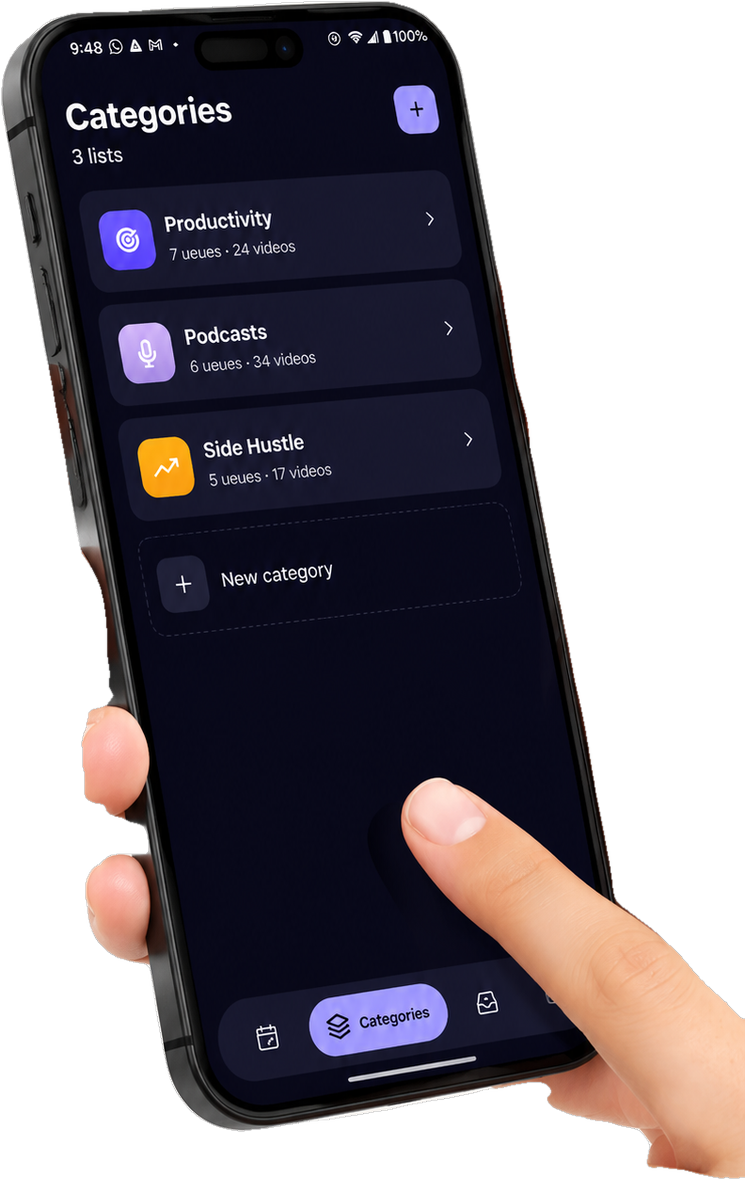
 Prism
Prism