Journal · Essay · 7 min
Sherlocked: what happens when Apple ships your app
By Ziyarex ·
The word comes from 2002. Karelia Software shipped Watson, a small Mac app that put web services (flights, movies, dictionaries) into a native interface. It was excellent and it sold. A year later Apple shipped Sherlock 3, which did the same things, came free with the OS, and ended Watson.
The verb stuck because the pattern kept repeating. Konfabulator's widgets became Dashboard. Growl's notifications became Notification Center. f.lux's warm evening screen became Night Shift. Duet and Astropad's iPad-as-second-display became Sidecar. 1Password's core job became a Passwords app in the menu bar.
If you build small utilities on Apple's platforms, you are building inside a blast radius. That's worth thinking about clearly rather than anxiously, because the outcomes have been much less uniform than the folklore suggests.
The three outcomes, and what separated them
Killed outright. Watson. Konfabulator, effectively, after being sold on. Growl, which limped for years and shut down in 2020. What these shared: the app was the feature. One capability, no workflow around it, nothing the OS version couldn't reach in a version or two. When the free version arrived, there was no remaining argument.
Badly wounded but alive. f.lux still exists, and is still better than Night Shift on several axes. Finer control, more platforms, more considered colour science. It also stopped being a thing most people install, because 90% of the value became a checkbox in Settings. This is the most common outcome and the most brutal, because it doesn't kill you. It caps you.
Barely scratched. 1Password was supposedly finished when Apple shipped Passwords in 2024. It wasn't, because password management for a person is a small feature and password management for a team, across four operating systems, with sharing and audit and recovery, is a business. Astropad kept going by chasing the professional end (pressure, colour accuracy, hardware) that Sidecar never addressed.
The line between those three isn't luck. It's this:
Apple ships the 80% case, for free, on one platform, and then mostly stops.
Every survivor lived in one of the other three quadrants: the last 20%, the paid depth, the platforms Apple doesn't care about, or the iteration speed Apple can't match on an annual release cycle.
What Apple actually does, in practice
It's worth being precise, because "Apple will copy it" is usually wrong in the details.
Apple ships the version that is defensible, universal and finished. It has to work for everyone, ship on a schedule, survive a keynote demo, and not require support. That forces a specific shape: fewer options, no edge cases, no per-user configuration, and, critically, very little change afterwards. Night Shift in 2026 is roughly Night Shift from 2017.
That last part is the whole opportunity. The OS feature is a floor, and it's a floor that doesn't move.
So what do you actually do about it
Assume it, and price it in. If your app is one capability with no depth, you have a window, not a business. That's a legitimate thing to build, just know which one you're building and don't be surprised at the end of it.
Own a workflow, not a feature. "Warm my screen" is a feature. "Manage my whole day's light" would have been a workflow. The distinction is whether removing your app leaves a gap someone has to fill with three other things.
Go where the annual release cycle can't. Ship on Tuesday. Respond to a user in an hour. Support the weird monitor, the eight-year-old Mac, the non-Apple phone. None of that is available to a platform team.
Be honest about competition, publicly. This one is underrated. If a free built-in does most of what you do, saying so, and saying exactly where it doesn't, earns more trust than the alternative, and the people who convert after reading it are the ones who actually needed the extra 20%. That's why our comparison pages name the competitors in the title and recommend against ourselves in places.
Where this leaves what we ship
Two of the things in our own catalogue sit squarely in the blast radius, and it would be strange not to say so.
Oreo puts live activities in the MacBook notch. Apple has already built exactly this concept on iPhone, called it the Dynamic Island, and shipped Live Activities as a public API. The Mac version of that story is not a question of if. Our position is: the notch is a UI surface, someone should be using yours, and if Apple eventually agrees, that will have been the correct opinion. Held early, by us, for $12.
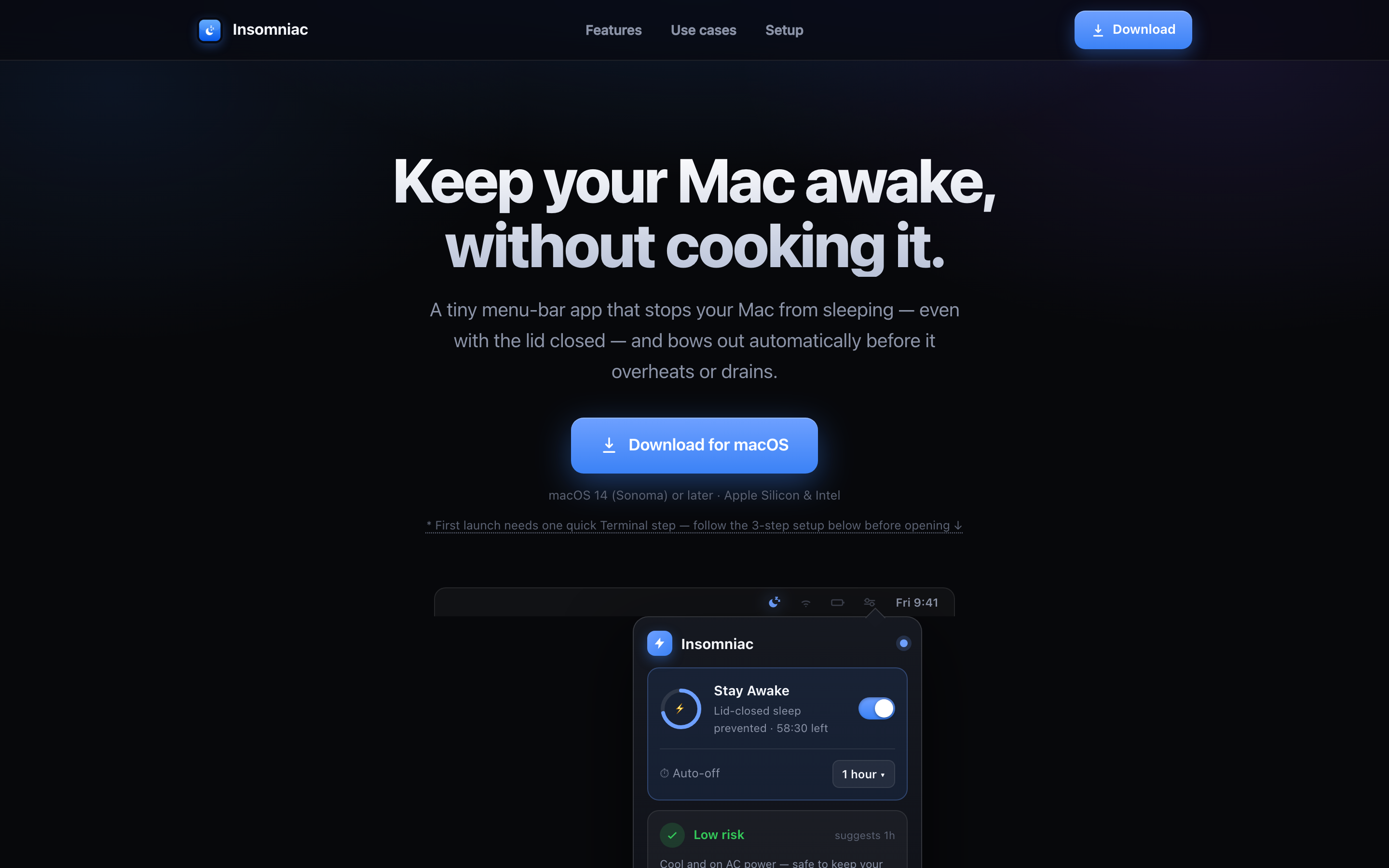
Insomniac is free, does one job, and is a thin layer over a pmset flag Apple could expose in Settings tomorrow. It exists because the thermal-safety part is the actual work, not the toggle.
Neither of those is a hedge. They're both bets that the last 20%, the part Apple ships without, is where the users who care actually live. That bet has a twenty-year track record of being sometimes right, and it's the only one available to anyone building small software on someone else's platform.
The alternative is to not build, and that's a worse plan.
 Oreo
Oreo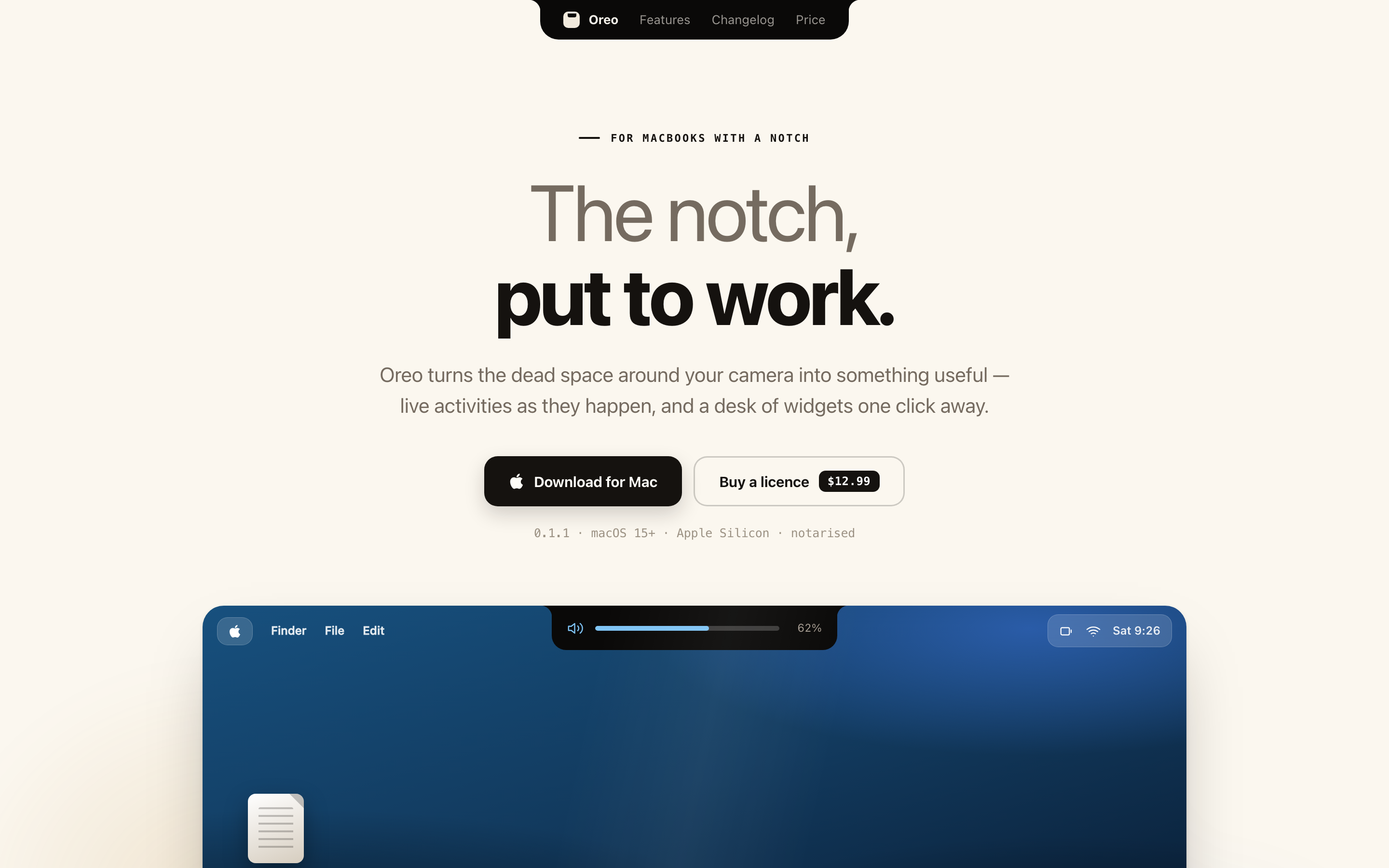
 Insomniac